

EDITORIAL CRITIQUE
Language in the Ordinary
A critical look at a photograph by Matt Mouser
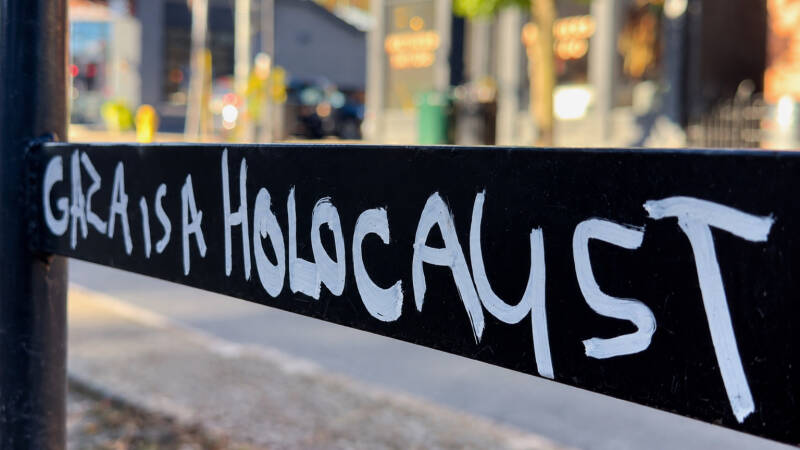
At first glance, the photograph appears almost confrontational in its simplicity: a black horizontal rail cuts across the frame, carrying an irregular message painted hastily in white. Much of the writing is rough and difficult to decipher, but one word arrives with unmistakable force: “HOLOCAUST.”
Behind it, everyday life continues.
Storefronts catch the late-day light. Cars sit along the street. Trees, windows and bits of color dissolve into a soft urban haze. Nothing in the background appears extraordinary. That ordinariness may be the most important thing in the photograph.
Mouser uses a shallow depth of field to separate the anonymous writing from the world surrounding it. The rail is immediate, dark and physical. The city behind it becomes atmosphere. This is no longer simply a photograph documenting graffiti; it becomes an image about the collision between language and place.
The word in the foreground carries enormous historical and emotional weight, yet it has been placed casually into the landscape of an ordinary neighborhood. Someone wrote it. Others have walked past it. Cars have driven beside it. Shops have opened and closed in front of it. Life continues around language capable of stopping a viewer in his tracks.
That tension gives the image its power.
The photograph does not provide the author of the message, its full context, or even an entirely legible sentence. Instead, the viewer encounters a fragment. That incompleteness matters. We are left not with an explanation but with a question.
What happens when a word this large is placed inside something this ordinary?
Mouser’s composition reinforces that discomfort. The black rail stretches across the photograph, functioning almost as a visual barrier between the viewer and the brighter world beyond it. The lettering presses against the confines of the frame. There is little room to escape it. Meanwhile, sunlight and color continue quietly behind the message.
The photograph therefore operates on two levels at once. It is a record of something encountered on a street, but it is also an image about how people leave language behind in public spaces—statements, accusations, memories, anger and fragments of thought deposited into places where strangers must encounter them.
There is an important restraint in the photograph as well. Mouser does not attempt to explain the message or construct an elaborate visual narrative around it. He notices it.
That act of noticing is central to observational photography. The photographer’s job is sometimes less about creating an event than recognizing when unrelated elements briefly form one: harsh white letters, a black surface, warm sunlight, an ordinary street and a word that refuses to behave like ordinary scenery.
The photograph’s greatest strength may ultimately be that contradiction.
The background says: “Another afternoon.”
The foreground says: “Stop.”
And somewhere between those two statements, the photograph begins.
SHORT WEBSITE EXCERPT
This tightly framed image transforms a piece of street writing into a charged visual encounter. By placing the painted rail in sharp focus against a soft, ordinary city backdrop, Matt Mouser creates a photograph about interruption, public language, and the tension between everyday life and words that refuse to be ignored.
“A street scene becomes something else the moment language demands that we stop and look.”